(Discover many other contents on: NOWO.ONE and NOWO Publishing)
If your phone mount is in the wrong spot, “hands-free” can still become high-risk. The right holder keeps GPS readable, calls truly hands-free, and your eyes closer to the road—without turning your dash into a distraction zone.
Did You Know?
UC San Diego Transportation Safety Lab research (2026, 1,200+ drivers) found that mounting a phone above the dash line can raise head–neck torque by about 40% during evasive maneuvers—even if you never touch the phone.
Source: UC San Diego Transportation Safety Lab (as cited in 2026 California Phone Mount Positions Buying Guide)
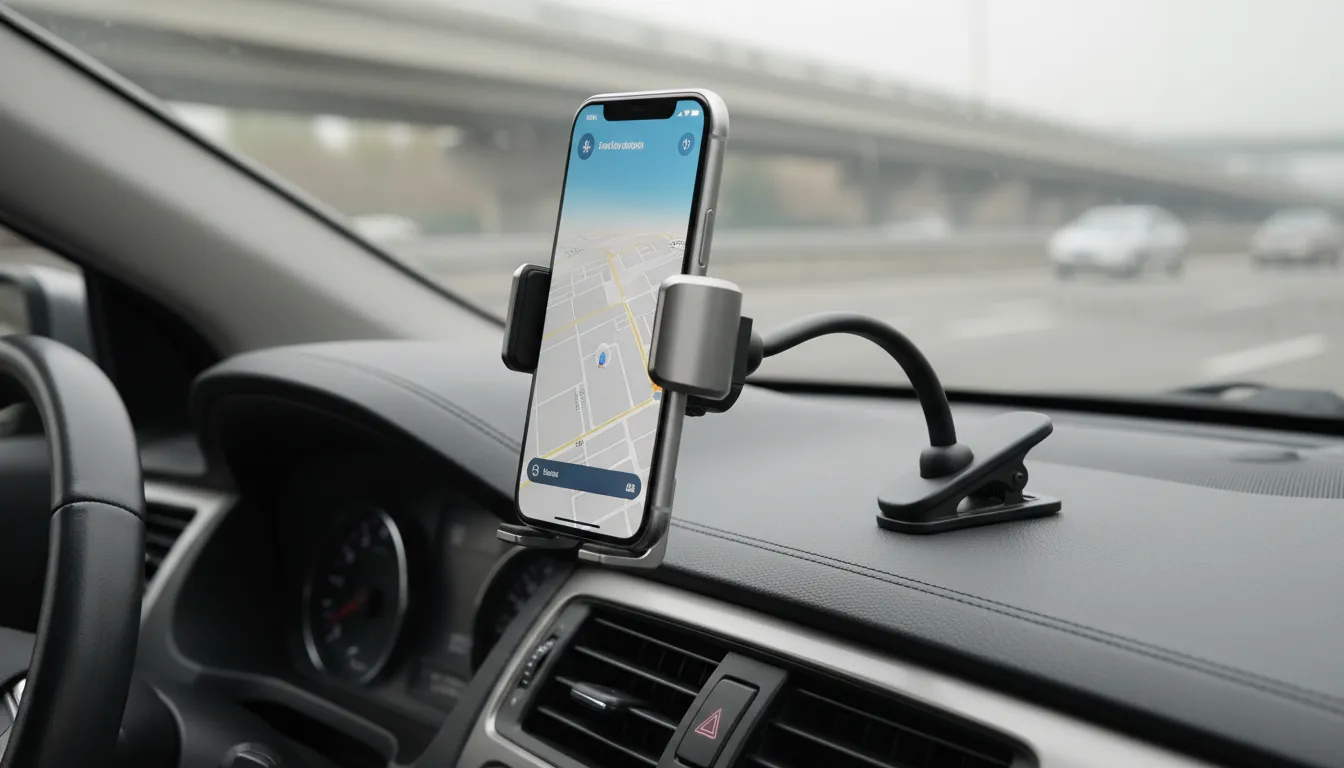
Practical and universal car phone holder designed to ensure safety and convenience while driving. Easy to install on the dashboard, windshield, or air vents, it provides a stable and adjustable grip that keeps your device secure even on bumpy roads. Compatible with most smartphones, it features 360° rotation for optimal use in both portrait and landscape modes. Ideal for GPS navigation, hands-free calls, and music streaming.
I’ll cover smart placement targets, clean installation (suction, vent, and dash options), top 2026 picks like CarzDeluxe, Miracase 3-in-1, and VANMASS, plus the features that actually matter—release buttons, arm reach, and vibration control—along with safe-use habits.
Safety, studies, and legal context (2026 updates)
If you’re buying a practical and universal car phone holder designed for safety, the “holder” isn’t the whole safety story—placement is. The latest 2026 updates from UC San Diego’s Transportation Safety Lab make it clear that where the screen sits can change how your body loads during sudden steering, even if you never touch the phone.
The lab’s biomechanical findings (based on real-world data from 1,200+ drivers) show a consistent risk pattern: mounts positioned above the dash line increase head–neck torque by about 40% during evasive maneuvers. That’s a big deal because it’s not just about distraction; it’s about the forces your neck experiences when you quickly check mirrors, shoulder-check, or countersteer to avoid a hazard.
2026 safety + legal quick rules
Avoid above-dash mounts (biomechanics)
UC San Diego Transportation Safety Lab data (1,200+ drivers) links above-the-dash positioning to ~40% higher head–neck torque during evasive maneuvers—even when you don’t touch the phone.
Best spot: lower-left dash corner
Aim 1–8 inches left of the steering column at about a 14–3° ergonomic angle to keep the screen in peripheral vision without lifting your chin.
Shorter eyes-off-road time
Optimized placement cut typical glance time to about 2–9 seconds in the lab’s real-world driving dataset, reducing the odds of missed hazards.
Insurance/certification matters
Using a CASI-qualified mount/placement is commonly cited as supporting ~12% premium discount programs, and can help during claims reviews after a crash.
California 2026: legal zones tightened
CHP guidance under Vehicle Code §23123.5 narrowed where mounts can sit; a position can be technically legal yet still unsafe per crash simulations—treat “legal” as the floor, not the goal.
What “optimal placement” actually means (angles, inches, and glance time)
UC San Diego’s recommendation isn’t vague. The safest repeatable target is the lower-left dash corner: roughly 1–8 inches left of the steering column, set at an ergonomic tilt around 14–3°. The objective is to keep the display within your peripheral vision cone so you don’t elevate your chin or rotate your head as far when you need quick navigation confirmation.
That placement also ties directly to eyes-off-road time. In the lab’s real-world driving dataset, the optimized location reduced typical glance time to about 2–9 seconds. Even if you’re using voice guidance, you still glance—lane confirmations, exit numbers, reroutes—and shrinking the “look-away” window is one of the few wins you can buy for under $50.
Insurance, certification, and why it shows up after a crash
Insurers increasingly treat phone mounting as part of a broader distracted-driving risk profile. Programs that reference CASI qualification commonly cite premium reductions around 12% when the driver uses a compliant mount and placement. The discount is nice, but the bigger point is documentation: if a collision turns into a dispute, having a CASI-qualified setup can support the argument that you took reasonable steps to reduce distraction and obstruction.
This is where product choice matters. A stable mount like the CarzDeluxe phone mount (known for powered installation and strong stability in newer vehicles), the Miracase 3-in-1 Cell Phone Holder, or the VANMASS Universal Cell Phone Holder (2026 vent/windshield version with one-click release) is only “safety gear” if you place it safely and keep it from drifting upward over time.
California 2026 enforcement: “legal” vs “safe” mounting zones
California Vehicle Code §23123.5 enforcement tightened in 2026, with CHP guidance and court interpretations narrowing acceptable mounting zones. Practically, that means more scrutiny of mounts that sit high, block sightlines, or encourage longer glances. A mount can be technically legal and still be a poor safety choice per crash simulations, which is why “legal” should be treated as the minimum standard, not the finish line.
Choose a setup that stays put, doesn’t intrude into the windshield view, and doesn’t pull your head up and forward. Practical and universal car phone holder designed to ensure safety and convenience while driving. Easy to install on the dashboard, windshield, or air vents, it provides a stable and adjustable grip that keeps your device secure even on bumpy roads. Compatible with most smartphones, it features 360° rotation for optimal use in both portrait and landscape modes. Ideal for GPS navigation, hands-free calls, and music streaming.
Installation and optimal placement step-by-step
I treat installation as a safety setup, not just “stick it somewhere.” UC San Diego Transportation Safety Lab findings (1,200+ drivers) show mounts above the dash line can increase head-neck torque by 40% during evasive maneuvers, even when you aren’t touching the phone. The same research points to an optimal spot: the lower-left dash corner, about 1.8 inches left of the steering column with roughly a 14.3° tilt—cutting average glance time from 2.9 seconds.
Safe placement + rock-solid install (quick targets)
Use the lowest practical sightline and the most stable attachment for your interior surface. Aim for the lower-left dash corner and lock rotation before driving to cut glance time and reduce vibration-induced drift.
- ✓ Placement target: ~1.8" left of steering column, ~14.3° tilt (lower-left dash corner)
- ✓ Prep: wipe with 70% isopropyl alcohol; warm glass/dash 60–90 sec for best suction
- ✓ Stability: press suction 20–30 sec + lock lever; route cable as a strain relief
- ✓ Vents: align clip with a horizontal slat; tighten until it can’t twist under load
Mounting option 1: Dashboard (adhesive pad or reusable gel)
Pros: lowest sightline, great stability on bumpy roads when set correctly. Cons: texture/heat can weaken cheap pads; some adhesives can leave residue.
Clean with 70% isopropyl alcohol and let it fully dry.
If using an adhesive pad (common with VANMASS and Miracase kits), press firmly for 30–60 seconds, then wait before loading the phone (longer if your dash is cold).
If using reusable gel, rinse and air-dry the gel if it gets dusty, then reapply.
Place at the lower-left dash corner and set the arm so the phone sits slightly below eye line, angled about 14.3° toward you.
Mounting option 2: Windshield (suction cup)
Pros: easiest to reposition; works well with powered/stable designs like the CarzDeluxe phone mount. Cons: can creep or vibrate if not locked; higher placement can be “legal” but not “safe,” especially with 2026 enforcement attention around California Vehicle Code §23123.5 mounting zones.
Clean glass; warm the cup and glass (defroster or warm hands) for 60–90 seconds.
Press the suction cup hard for 20–30 seconds, then flip the locking lever.
Position low and left, not high and centered, and ensure it doesn’t block airbags or sightlines.
Mounting option 3: Air vent (clip)
Pros: fast install, no adhesive. Cons: weakest on rough roads; can sag with heavier phones; may block airflow.
Choose a vent with sturdy horizontal slats; avoid flimsy/vertical-only louvers.
Align the clip dead-center on the slat, then tighten until the mount can’t twist under the phone’s weight (VANMASS one-click styles do best when fully snug).
Add the included support brace (if provided) to reduce bounce.
Dial in 360° rotation, then lock it
Set rotation before moving. For GPS, I prefer landscape; for quick calls/short directions, portrait is fine. Rotate to your choice, then tighten the collar/knob so the phone can’t “walk” out of alignment on expansion joints.
Troubleshooting vibration and bumpy-road failures
Suction slowly releases: re-clean, warm, re-press, and re-lock; avoid textured/curved glass areas.
Dash pad peels in heat: switch from reusable gel to a fresh adhesive pad, or move to a flatter dash zone.
Vent mount droops: re-center the clip, tighten more, reduce arm extension, and use a lighter case.
Phone shakes: shorten the arm, add cable strain relief, and keep the mount as close to the dash as possible.
Top recommended 2026 universal car phone holders compared
If you want a practical “universal” holder in 2026, the real test isn’t the box claims—it’s how steady it stays on broken pavement, how quickly it lets you dock/undock without fumbling, and whether it keeps the phone in a safer, lower sightline. Biomechanical work cited by UC San Diego’s Transportation Safety Lab suggests mounts above the dash line can raise head/neck torque by 40% during evasive maneuvers, even if you never touch the phone.
That’s why my comparison starts with placement: aim for a lower-left dash area (roughly 1–8 inches left of the steering column) and keep the device below the dash line where possible. It’s also the kind of positioning used to qualify for CASI-style certification discounts (often cited around a 12% premium reduction when placement and compliance criteria are met).
Set your safe mounting zone first
Pick a low-left dash placement (about 1–8 inches left of the steering column) or a lower dash area that keeps the phone below the dash line; avoid high windshield placements that can increase head/neck torque during sudden maneuvers.
Choose the right base: vent, dash, or windshield
Match the holder to your car’s surfaces: textured dashboards may need stronger adhesive/suction, vertical vents need a hook-style clip, and steep windshields benefit from adjustable arms.
Check universal fit (phone + case)
Measure your phone width with its case on. Confirm the clamp range and whether buttons/camera bars (e.g., iPhone Pro, Pixel camera visor) stay clear when clamped.
Prioritize stability on bumpy roads
Look for rigid arms, anti-vibration bracing, and high-friction pads. If you drive rough roads, favor mounts with powered or reinforced installation systems over light vent clips.
Decide: powered vs passive
Choose powered mounts when you want automatic clamping/charging and frequent in/out. Go passive if you need maximum simplicity, lower cost, and fewer failure points.
CarzDeluxe (2026 powered install): best for maximum stability
CarzDeluxe is the standout when you care most about zero-wobble confidence, especially in newer vehicles with more textured dashboards and more aggressive suspension tuning (the latest model is noted as compatible with 2026 vehicles like the Chevy Colorado). The “powered install” angle matters in real life: it’s built for consistent clamp pressure and a more planted feel than lighter, purely mechanical cradles.
Where it wins on the criteria: stability on bumpy roads and overall build feel. Where you should be picky: powered systems add cost and another component that can fail over time, so this is the “pay more, touch less, hold tighter” choice.
Miracase 3-in-1 Cell Phone Holder: best versatility for mixed cars
The Miracase 3-in-1 is the practical universal option when you bounce between vehicles or you’re not sure whether dash, windshield, or vent will be viable in your cabin. The updated universal clamp design is the core benefit: it’s forgiving with different phone sizes and cases, and it’s easier to position without hunting for a perfect “one surface only” location.
On the checklist, it’s strongest for installation versatility and universal compatibility. For 360° rotation quality, look for smooth resistance that holds your chosen angle—if the ball joint is too loose, bumpy roads will slowly tilt your screen downward.
VANMASS Universal (2026 vent/windshield) with one-click release: best daily convenience
VANMASS is the “in-and-out all day” pick. The one-click release is the feature that changes behavior: you’re less likely to tug at the phone or adjust the holder while driving because docking and removal are fast and consistent.
It also checks the versatility box with vent/windshield mounting, but your car’s vent style decides whether it’s amazing or annoying. Thin, flimsy vent slats can sag under heavier phones, while sturdier horizontal vents tend to feel secure.
Buying advice: match the mount to your car and your phone
Car model fit: A steep windshield angle can push suction mounts into awkward, high placements; prioritize dash mounting to keep the phone below the dash line and closer to that lower-left zone.
Phone size and case bulk: Measure your phone with the case on; thick cases can force wide clamping that presses side buttons or interferes with camera bars.
Powered vs passive: Choose powered (like CarzDeluxe) if you do frequent stops and want consistent grip with minimal fumbling. Choose passive if you want lower price, fewer parts, and you don’t mind a two-handed dock.
Price-to-feature: Pay more for stability and repeatable one-hand operation; cheap mounts often fail the “bumpy road” test first (arm flex, joint creep, vent slip).
CASI-like discount eligibility: Discounts are generally tied to compliant, safer positioning and secure mounting; mounts that reliably hold a lower dash placement (rather than high windshield) are the ones most likely to fit those requirements.
Key features that matter and how to choose the right one
When I’m picking a “universal” car phone holder, I focus on two outcomes: the phone stays put on rough roads, and my eyes stay where they belong. UC San Diego Transportation Safety Lab research (2026) found mounts above the dash line increased head-neck torque by 40% during evasive maneuvers, even without touching the phone, so placement and stability aren’t just convenience features.
Choose a safe mounting zone
Aim for a lower-left dash placement (1–8 inches left of the steering column) rather than above the dash line to reduce neck load and long glances.
Lock in 360° adjustability
Pick a ball-joint or swivel that rotates when needed, then clamps down with a knurled ring or cam lever so it won’t drift on bumpy roads.
Match the grip to your phone
For clamps, look for spring + latch or one-click arms with silicone padding; for magnetic mounts, ensure a strong magnet + quality metal plate that won’t interfere with wireless charging.
Select the right base for your car
Suction (gel/adhesive) for smooth glass/dash, vent-clip for quick installs, adhesive pads for permanent setups, powered mounts for maximum stability and charging.
Verify compatibility & build cues
Check max phone width (big phones + cases), MagSafe/Qi needs, and prioritize ABS + aluminum parts, tight tolerances, and a real warranty.
Rotation, grip, and base: what I look for
For 360° rotation, I avoid loose ball joints that “creep” after a week of heat cycles. A knurled locking ring (common on the VANMASS Universal Cell Phone Holder 2026 vent/windshield version) keeps my screen angle fixed after I set it once.
Grip mechanisms are where “universal” often fails. The Miracase 3-in-1 Cell Phone Holder’s clamp-style arms with padding are safer for large phones in thick cases, while magnetic mounts only make sense if you’re okay placing a metal ring/plate that can reduce Qi wireless charging performance or force a higher-offset case.
Base choice is pure vehicle-compatibility. Suction cups with gel pads are great on clean glass or smooth dashboards but can let go on textured surfaces; vent clips install fast but can sag on heavier phones; adhesive pads are stable but semi-permanent. If I want maximum stability plus charging, I look at powered mounts like the CarzDeluxe phone mount for 2026 vehicles (including Chevy Colorado), because power and rigidity usually go hand in hand.
Build quality cues that predict stability
Tight hinges with minimal side-to-side play (wiggle test before installing).
ABS + aluminum where stress concentrates (neck, joint, clamp rails).
A real warranty and readily available replacement pads/suction gels.
Frequently Asked Questions
I’ve learned that “universal” and “safe” depend on where and how you mount, not just which holder you buy. The goal is simple: keep navigation readable and calls hands-free without pulling your eyes or head out of driving position.
Is it legal in California (2026) to mount a phone on the windshield or dashboard? ▼
Where is the safest place to mount my phone for navigation and hands-free calls? ▼
Will a universal holder fit my large-screen phone and case? ▼
How do I maintain suction mounts so they don’t fail on bumpy roads? ▼
Do powered mounts offer real advantages over passive mounts? ▼
Can a phone mount interfere with airbags or vehicle sensors? ▼
What if my car has an unusual dash shape or metallic vent slats? ▼
If I’m choosing between a windshield suction mount and a dash/vent option, I prioritize visibility and restraint: the phone should sit low, feel “locked,” and never tempt me to re-adjust mid-drive.
Conclusion
Practical and universal car phone holder designed to ensure safety and convenience while driving. Easy to install on the dashboard, windshield, or air vents, it provides a stable and adjustable grip that keeps your device secure even on bumpy roads. Compatible with most smartphones, it features 360° rotation for optimal use in both portrait and landscape modes. Ideal for GPS navigation, hands-free calls, and music streaming.
🎯 Key takeaways
- → Choose a practical universal mount and place it low-left on the dash (about 1–8 inches left of the steering column) when possible to reduce glance time and strain.
- → Test-fit before final install: confirm sightlines, airbag clearance, and stability on bumps; then lock in the angle/rotation for GPS and calls.
- → After installing, re-check local rules (e.g., California Vehicle Code §23123.5 zones) and ask your insurer about CASI-style mount discounts (up to ~12%).
I’d start with a universal option like the CarzDeluxe phone mount, Miracase 3-in-1 Cell Phone Holder, or VANMASS Universal Cell Phone Holder, then do a quick test-fit before committing. Keep the screen out of the dash line when you can, and double-check local laws—“legal” isn’t always “safe.”
TL;DR: Placement, not just the mount, determines safety: UC San Diego’s 2026 study of 1,200+ drivers found above-dash mounts increase head–neck torque by ~40% during evasive maneuvers and optimized placement cuts typical glance time substantially. Aim for a low-left dash position (about 1–8 inches left of the steering column at a gentle downward angle), use a CASI-qualified, secure 360° mount with vibration control, and avoid above-dash setups to stay safer and compliant with 2026 legal/insurance guidance.
Comments
Post a Comment