(Discover many other contents on: NOWO.ONE and NOWO Publishing)
Your phone captures everything—receipts, class notes, mood boards, travel memories—but sharing it often still means scrolling. A portable Bluetooth mini printer makes those moments tangible in seconds, whether you’re labeling pantry jars or handing a friend a tiny photo.
Did You Know?
Most 2026 pocket photo printers aren’t inkjets at all—they use Zink, dye-sublimation, or Instax film, delivering an effective ~300 DPI while typically squeezing about 20–100 prints from a charge, depending on the model.
Source: March 2026 roundup summaries cited in the provided research links (Tom’s Guide/RTINGS/Digital Camera World).
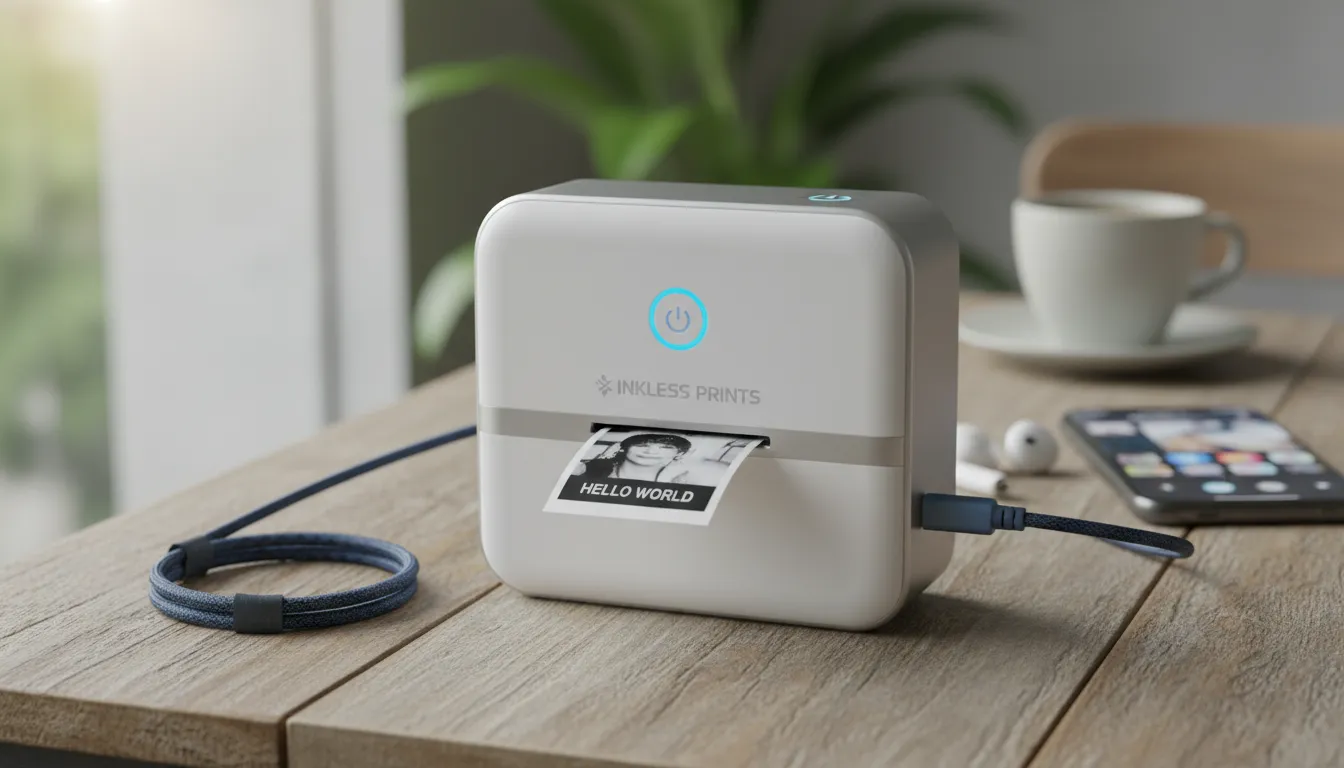
Portable Bluetooth mini printer, compact and lightweight, perfect for printing photos, notes, labels, and reminders directly from your smartphone. Thanks to wireless Bluetooth connectivity, it is easy to use without the need for cables. It supports multiple print formats and is compatible with both iOS and Android devices. The built-in rechargeable battery ensures long-lasting use, making it ideal for home, office, school, or travel. Modern and functional design, available in various colors.
Next, you’ll see which models stand out (like Fujifilm Instax Mini Link 2, Polaroid Hi-Print, and Phomemo M08F), how pairing works, what “good” print quality looks like, and smart battery and travel tips.
Why choose a portable Bluetooth mini printer
A portable Bluetooth mini printer earns its keep because it’s genuinely easy to carry. Models like the Fujifilm Instax Mini Link 2 are small enough for a backpack or tote, so you can print on the spot—at school, in the office, or while traveling—without hunting for a shared printer.
Bluetooth pairing is the real quality-of-life upgrade. You open the companion app, connect once, and print directly from your smartphone with no cables. Most popular options are designed for both iOS and Android, so swapping between an iPhone and a work Android phone is usually painless.
Pocket-friendly portability
Slip models like the Fujifilm Instax Mini Link 2 into a tote or backpack for journaling, study notes, and travel prints without lugging a full printer.
Cable-free phone printing
Bluetooth pairing lets you print directly from iPhone or Android apps—no Wi‑Fi setup, no USB cords—ideal for quick, on-the-go output.
Versatile output for daily life
Use photo-focused options like Polaroid Hi-Print for vibrant 2x3 keepsakes, or pick thermal models (e.g., Phomemo M08F) for notes, labels, and reminders.
Modern design that matches your vibe
Many mini printers come in playful colors and clean, minimalist shells, so your desk setup and travel kit still look intentional.
Portable Bluetooth mini printer, compact and lightweight, perfect for printing photos, notes, labels, and reminders directly from your smartphone. Thanks to wireless Bluetooth connectivity, it is easy to use without the need for cables. It supports multiple print formats and is compatible with both iOS and Android devices. The built-in rechargeable battery ensures long-lasting use, making it ideal for home, office, school, or travel. Modern and functional design, available in various colors.
Top portable models and side-by-side comparison
Portable Bluetooth mini printers in 2026 fall into two camps: photo-first models (Instax film, dye-sublimation, or Zink) and productivity-first thermal printers for notes, labels, and documents. Most deliver an effective ~300 DPI look for their category, but the “best” choice depends more on print size, media cost, and battery than on raw resolution.
2026 quick pick: match the printer to your prints
Photo printers (Instax/dye-sub/Zink) trade speed and convenience for ongoing paper/film cost; thermal wins for labels, notes, and multi-page documents.
- ✓ Best photos: Fujifilm Instax Mini Link 2 (Instax film) or Polaroid Hi-Print (dye-sub)
- ✓ Best pocket Zink: Canon Ivy 2 or HP Sprocket Select (2x3 / 2.3x3.4)
- ✓ Best notes/labels & longest runs: Phomemo M08F (thermal, A4/Letter capable)
Side-by-side: what you actually get
Fujifilm Instax Mini Link 2: Instax film (instant/thermal exposure). Prints around 2.8" wide with the classic Instax border look; vibrant and “analog-cute” rather than razor-sharp. Battery is a standout at up to ~100 prints/charge. Great app creativity and remote camera control, but it uses Micro-USB, and Instax film is typically a premium ongoing cost.
Polaroid Hi-Print (2x3): Dye-sublimation on 2x3" sheets. This is the pick when you want the most “real photo” finish (smooth gradients, strong color) in a mini size. Expect shorter stamina at around ~20 prints/charge, and it’s photo-only—no receipts, no labels.
Canon Ivy 2: Zink (zero-ink) on 2x3" sticky-backed photo paper. Zink is convenient for journaling and scrapbooks, with decent ~300-DPI-class output, but blacks and subtle tones can look flatter than dye-sub. Battery life typically lands in the mid range (roughly 20–50 prints depending on usage).
HP Sprocket Select: Zink with a slightly larger feel (often 2.3x3.4"). The bigger print can look more “shareable” on a fridge or in a travel journal. Similar Zink tradeoffs apply: fast, simple, and sticker-friendly, but not the richest tonal depth.
Phomemo M08F: Thermal (inkless) document/label printing, including A4/Letter-capable output on compatible thermal paper. It’s the best match for shipping labels, study notes, checklists, and travel documents. You give up photo quality and long-term archival stability, but you gain utility and often the broadest real-world battery range (roughly 50–100 pages/prints per charge depending on format and density).
Best-by-use-case (fast picks)
Best for photos: Polaroid Hi-Print for the most polished mini photo finish; Instax Mini Link 2 if you love the instant-film aesthetic and want more prints per charge.
Best for labels/notes: Phomemo M08F—especially if you need multi-page printing, templates, and practical outputs beyond photos.
Best battery life: Fujifilm Instax Mini Link 2 (commonly cited up to ~100 prints) and Phomemo M08F for long document runs.
Best app editing tools: Instax Mini Link 2 tends to lead for playful edits, collages, and shooting features; Zink apps (Canon Ivy 2 / HP Sprocket Select) are strong for stickers, frames, and quick social prints.
For price bands, Zink mini printers (Canon Ivy 2, HP Sprocket Select) often sit in the accessible mid-range, while dye-sub refills and Instax film push total cost higher over time. If you’ll print frequently, compare the per-print media packs as carefully as the hardware.
How to set up, pair and print from your smartphone
Most compact Bluetooth mini printers are designed to be “app-first,” so your fastest path to a clean first print is: charge, load the correct media, pair inside the brand app, then run a single test. Whether you’re using a photo printer like the Fujifilm Instax Mini Link 2 or Polaroid Hi-Print, or a thermal document/label model like the Phomemo M08F, the setup pattern is nearly identical.
Charge + load the right media
Fully charge (USB-C or Micro-USB) and load paper/film: Zink photo sheets (e.g., Canon Ivy/HP Sprocket), dye-sub cartridge+paper (Polaroid Hi-Print), Instax film pack (Fujifilm Instax Mini Link 2), or thermal rolls/sheets (Phomemo M08F).
Install the companion app
iOS: App Store. Android: Google Play. Use the brand app (Instax Mini Link, Polaroid Hi-Print, HP Sprocket, Canon Mini Print, Phomemo). Create an account only if required for templates/cloud sync.
Pair over Bluetooth (in-app first)
Turn the printer on, enable Bluetooth, then pair inside the app (often more reliable than Settings). If prompted, allow Bluetooth access and nearby devices permissions (Android) / Bluetooth permission (iOS).
Allow permissions + run a test print
Grant Photos/Media access so the app can import images. Then print the built-in sample or a single photo/label to confirm feed direction, color profile, and that the printer is set to the correct paper type.
Choose format + edit
Pick Photo/Label/Note modes. Use crop, brightness, filters, text, frames, QR/barcodes (label apps), collages, and templates. Save presets for repeat jobs like shipping labels or event strips.
Optimize speed + battery
Queue in batches, keep the phone close, disable Live Photos/RAW exports, and lower preview resolution if the app allows. For long sessions, turn off LED/AR features, enable battery saver, and avoid printing while charging on weak power banks.
Best practices inside the app (so prints look right)
Start by selecting the correct mode: “Photo” for Zink/dye-sub/Instax apps (HP Sprocket, Canon Mini Print, Polaroid Hi-Print, Instax Mini Link), and “Document/Label” for thermal apps like Phomemo. If the app has a paper setting (glossy/matte, border on/off, “Instax Rich/Natural”), set it before you edit—changing it later can shift color and contrast.
Use built-in templates for speed: collages for party strips, frames for scrapbooking, and saved label layouts for repeat tasks. For bulk jobs, prepare everything first (crop, add text, apply filters), then print in one queue rather than sending prints one-by-one.
Troubleshooting: pairing, feeds, and updates
If Bluetooth pairing fails, close the app, toggle Bluetooth off/on, and forget the device in iOS Bluetooth settings or Android’s paired devices list. Then re-pair from inside the app, keeping your phone within a few feet and away from crowded 2.4 GHz environments (routers, earbuds).
Feed problems depend on technology: Zink printers can misfeed if sheets are upside down or the blue calibration card is missing; dye-sub units like Polaroid Hi-Print need the cartridge seated cleanly; thermal printers like Phomemo M08F are sensitive to roll width and tension. Update the app and printer firmware when prompted—firmware fixes often improve connection stability and paper handling.
Print formats, image quality and ongoing costs
Mini printers fall into two camps: pocket photo printers (2x3, 2.8x3, 3x4) and thermal printers for notes/labels (custom roll sizes). Getting the size right matters more than people expect, because it dictates what you’ll actually print day to day.
Pick your print size
Match your goal to the format: 2x3" (wallet-size), 2.8x3" Instax Mini, 3x4" larger photo strips, or custom label widths on thermal label printers.
Choose print technology
Zink and dye-sub aim for ~300 DPI effective photo output; Instax film trades pure sharpness for a classic instant look. Thermal label printers prioritize crisp text/QR codes over gradients.
Calculate ongoing cost
Compare consumables: Instax film packs, dye-sub cartridge+paper sets, Zink paper, or thermal label rolls. Multiply typical cost-per-print by your monthly volume before buying the hardware.
Supported formats: what prints what
For photos, 2x3” is the common “sticky-back” size used by Zink models like the Canon Ivy/HP Sprocket class, while the Polaroid Hi-Print 2x3 uses dye-sublimation for smoother gradients and richer color. If you love the instant-camera vibe, the Fujifilm Instax Mini Link 2 prints Instax Mini film at roughly 2.8x3” (with the iconic white border), which makes it feel more like a keepsake than a sticker.
For notes and labels, thermal models like the Phomemo M08F are the practical pick: they handle custom paper/label widths on rolls, making them better for shipping labels, pantry labels, QR codes, and study notes than any photo printer.
Expected image quality: “~300 DPI” isn’t the whole story
Many pocket printers land around an effective ~300 DPI, but they look different. Dye-sub (Polaroid Hi-Print) tends to hide banding and handles skin tones and sunsets more gracefully. Zink is convenient and dry-to-touch, but fine detail and dark shadows can look a bit compressed, especially on busy scenes.
Instax film often looks “punchy” and analog; sharpness isn’t its flex, but the texture and contrast can be exactly what you want for parties and scrapbooks.
Consumables and ongoing cost: the real budget test
Photo printers cost more to feed than to buy. Expect rough per-print ranges of about $0.50–$1.50 depending on whether you’re buying Zink paper, dye-sub cartridge/paper packs, or Instax film (often the priciest but also the most giftable). Thermal label rolls are typically far cheaper per label, but they’re usually monochrome and not meant for gallery-style photos.
Choose photo-focused models if you’ll print memories and gifts; choose a thermal note/label printer if volume and cost-per-print matter more than color.
Practical use cases, creative ideas and productivity tips
A portable Bluetooth mini printer earns its keep when it lives where decisions happen: by your keys, in your backpack, or in a classroom tote. The trick is matching the job to the right printing style—thermal for notes/labels, and Zink/dye-sub/Instax for photos and keepsakes.
Everyday & productivity wins (Phomemo M08F + Niimbot D11)
Turn a pocket printer into a daily workflow tool: fast labels, quick notes, and tidy organization from your phone.
- • Print sticky-note reminders and to-do strips before you forget them (thermal paper).
- • Label pantry jars, cables, chargers, and file folders for instant findability.
- • Batch-print attendance tags or meeting name cards from a saved template.
- • Save common formats (QR codes, return addresses) in-app for one-tap reprints.
Creative mini prints (Polaroid Hi-Print + Fujifilm Instax Mini Link 2)
Use photo-focused mini printers to make keepsakes and event extras on the spot—great for gifts and social sharing.
- • Print 2x3" photos for mini albums, scrapbooks, and journal spreads.
- • Make party name tags and memory boards with instant guest photos.
- • Use app frames/collages to build themed sticker sheets (if your model supports sticker-backed media).
- • Pair with Instagram/Google Photos to print highlights right after a trip.
Workflow tips that make mini printers feel “instant”
Build a small template library: one label size for pantry jars, one for file spines, one for student flashcards, and one “meeting kit” sheet (agenda header + action-item boxes). When you’re on a Polaroid Hi-Print or Fujifilm Instax Mini Link 2, save favorite borders and collages so a photo is ready in a couple taps.
Batch printing beats one-off printing: capture notes during a meeting, then print all labels/handouts at once to reduce Bluetooth reconnects. For faster capture, pair with Google Photos or Instagram for quick photo pulls, and keep a short “print queue” album so you’re not hunting through your camera roll.
Battery life, portability and travel considerations
Important Insight
Real-world battery life is usually measured in prints, not hours: expect roughly 20–100 prints per charge depending on tech and brightness. Prioritize USB‑C charging and power‑bank compatibility for trips.
Most portable Bluetooth mini printers use a built-in rechargeable battery, and “good” endurance means finishing a day of casual printing. Dye-sub models like the Polaroid Hi-Print often land closer to the low end (around 20 prints), while Instax-style printers like the Fujifilm Instax Mini Link 2 can stretch to around 100 prints with conservative use.
If you carry it daily, look for a palm-sized body that slips into a sling bag and doesn’t need a bulky case. For travel, dimensions matter less than protection: a rigid sleeve prevents button presses and keeps film/paper flat.
Charging options and battery-care tips
Prefer USB-C; Micro-USB (e.g., Instax Mini Link 2) is workable but less convenient.
Choose a printer that charges from a power bank (5V USB) for trains and airports.
Preserve battery health: don’t store it fully drained, and avoid baking it in a hot car.
Practical travel checklist
Spare Zink paper, Instax film, or dye-sub cartridges (matched to your model)
Short USB-C cable (plus the right adapter), and a slim protective case
Update the companion app (Polaroid, Fujifilm Instax) before departure for offline reliability
Frequently Asked Questions
If you’re shopping for a portable Bluetooth mini printer that’s compact and lightweight, these are the questions that matter most—especially around phone compatibility, battery, and what “inkless” really means.
Can I print from both iPhone and Android phones? ▼
How long does the battery last, and how many prints per charge can I expect? ▼
Are there ink cartridges to replace, or is it inkless? ▼
Which models are best for labels and small notes versus photos? ▼
What print sizes and resolutions are typical for mini printers? ▼
One last practical tip: mini printers are optimized for quick, shareable output. If you need full-page documents, that’s where larger portable all-in-ones (like HP OfficeJet 250) start to make more sense than a pocket photo/label printer.
Conclusion
Portable Bluetooth mini printer, compact and lightweight, perfect for printing photos, notes, labels, and reminders directly from your smartphone. Thanks to wireless Bluetooth connectivity, it is easy to use without the need for cables. It supports multiple print formats and is compatible with both iOS and Android devices. The built-in rechargeable battery ensures long-lasting use, making it ideal for home, office, school, or travel. Modern and functional design, available in various colors.
🎯 Key takeaways
- → Pick your mini printer by priority: vivid photos (Fujifilm Instax Mini Link 2, Polaroid Hi-Print) vs notes/labels (Phomemo M08F thermal).
- → Buy the essentials first: the right film/paper rolls plus a slim case; then pair over Bluetooth and test the iOS/Android app templates.
- → Start a small project today—travel journaling, pantry labels, study flash notes—and refine your setup for battery, paper refills, and carry-on space.
If you want sticker-like snapshots, start with Polaroid Hi-Print; for instant-film vibes, choose Fujifilm Instax Mini Link 2. If you need tidy workflows, go thermal with the Phomemo M08F, then stock paper/film, add a protective case, and test the app’s templates before traveling. Try one creative project this week—pantry labels, a study revision strip, or a mini trip diary—and tweak settings for speed, contrast, and packability.
TL;DR: Portable Bluetooth mini printers let you instantly turn phone photos, notes, labels and reminders into tangible prints—compact, cable-free, and ideal for travel, school, or journaling. Most 2026 pocket printers use Zink, dye‑sublimation, or Instax (≈300 DPI) and typically deliver 20–100 prints per charge; standout models include the Fujifilm Instax Mini Link 2, Polaroid Hi‑Print, and Phomemo M08F.
Comments
Post a Comment